.png)
Under Sink & Reverse Osmosis Systems
Enjoy bottled-water quality right from your kitchen tap. Our under-sink and Reverse Osmosis (RO) systems provide the highest level of purification for drinking and cooking.
Request an Estimate
$50 Off First Time Customer
New to H2O Plumbing? Save $50 on your first service call. Welcome to the family!
Valid through December 31, 2026
Serving Local Cities
How Reverse Osmosis Works
RO systems are the gold standard for home water purification. Here is how a typical 5-stage system transforms tap water into ultra-pure drinking water.
Stage 1: Sediment Filter
Removes large particles like rust, sand, and dirt that can damage the system.
Stage 2 & 3: Carbon Block
Removes chlorine, chloramines, and VOCs that cause bad taste and odors.
Stage 4: RO Membrane
The core of the system. Removes heavy metals, fluoride, arsenic, and PFAS.
Stage 5: Polishing Filter
A final carbon filter that "polishes" the water right before it reaches your glass.
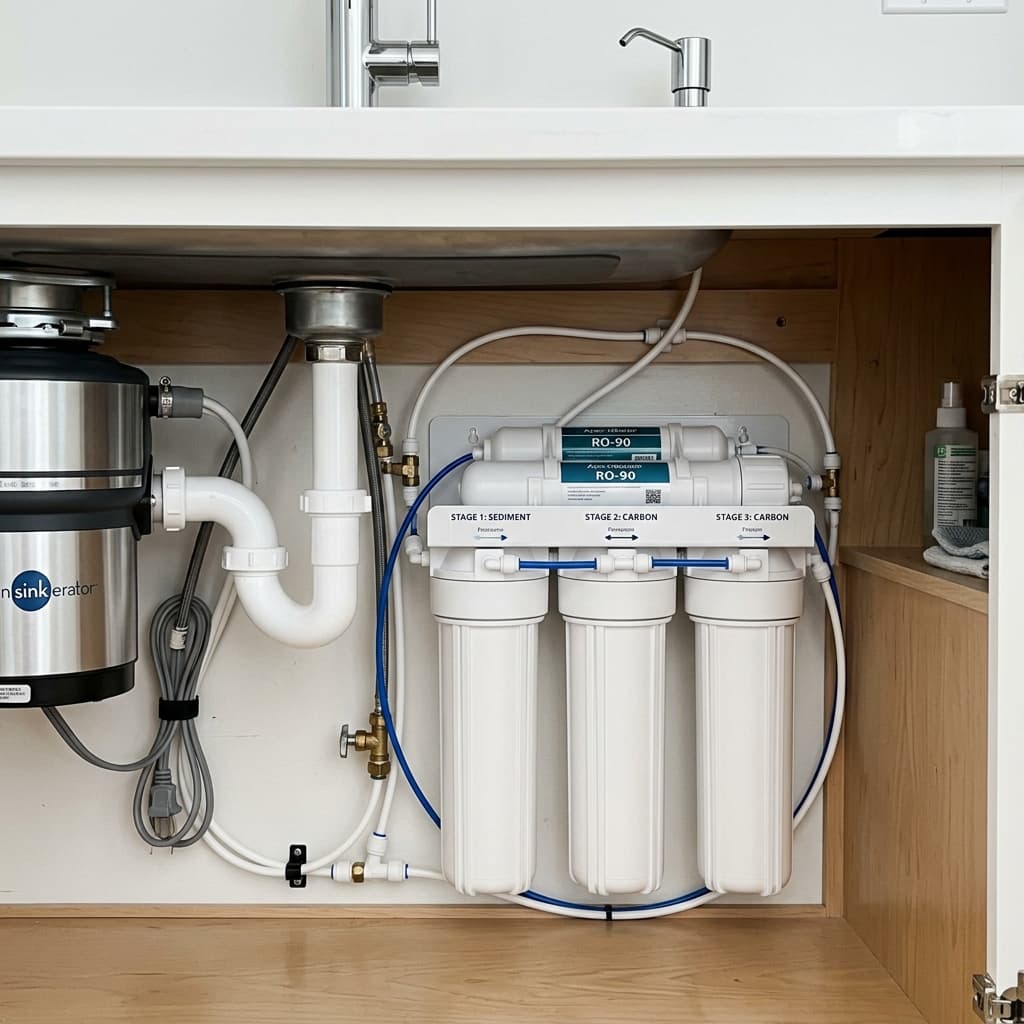
Clean, Out-of-Sight Installation
We install our systems neatly tucked away under your kitchen sink. We route all tubing perfectly, ensure the storage tank fits comfortably alongside your cleaning supplies, and leave your cabinet looking spotless.
- Leak-free professional connections
- Elegant countertop faucet installation
- Pressure testing & system flush included
Frequently Asked Questions
Q:What is Reverse Osmosis (RO)?
A:Reverse Osmosis is a multi-stage water purification process that pushes water through a semi-permeable membrane. This membrane has microscopic pores that block 99% of contaminants like lead, chlorine, fluoride, and forever chemicals (PFAS), leaving you with ultra-pure drinking water.
Q:How often do I need to change the filters?
A:For a standard 5-stage RO system, the pre-filters (carbon and sediment) should be replaced every 6 to 12 months. The actual RO membrane usually lasts 2 to 3 years depending on your initial water quality.
Q:Will this affect my water pressure?
A:An RO system stores purified water in a small, dedicated pressurized tank under your sink. When you turn on the RO faucet, you will have great pressure for filling glasses and pots. It does not affect the pressure of your main hot and cold kitchen faucet.
Q:Do you have to drill a hole in my countertop?
A:RO systems require a dedicated drinking water faucet. If you have an existing hole (often used for a soap dispenser or sprayer), we can use that. If not, we can professionally drill a hole in most countertop materials, including quartz and granite.